

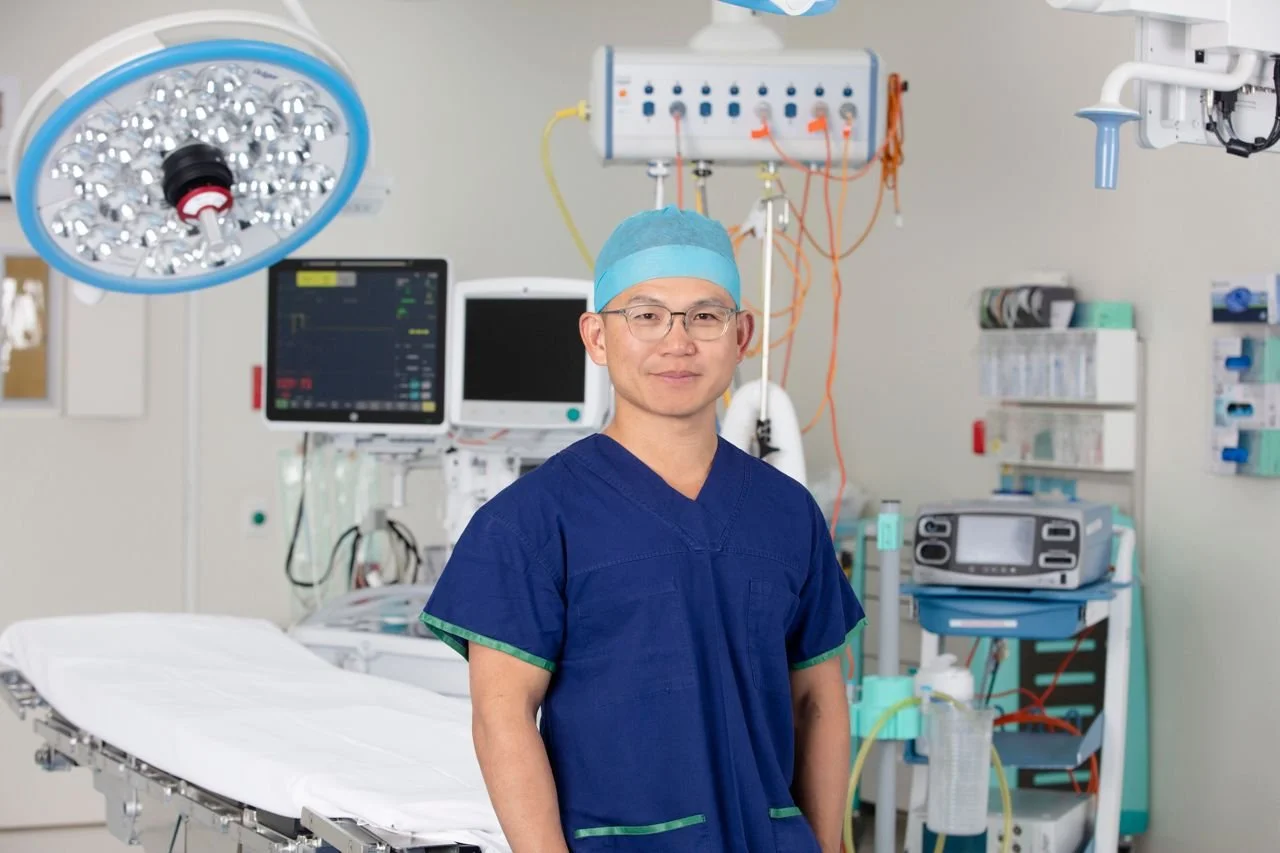
Preparing for Surgery
We understand that having surgery can be a stressful event. A/Prof. Lee and his team aims to make this experience as smooth and positive as possible.
Preparing for Surgery
These are some of the things to consider when it comes to preparing for your surgery. Remember, this is generic information. A/Prof. Lee will discuss the following in detail with you prior to scheduling surgery.
You will be asked to complete a health questionnaire either in writing or online.
It is always a good idea to confirm with your private health insurance, whether your level of cover includes the procedure you need to be performed in a private hospital, as there are many different levels of private hospital cover. Finding this out early may avoid last minute cancellations or change of plans.
Some patients may require additional tests before surgery. You will be provided with request forms for these tests.
You may be required to see other doctors prior to the surgery, such as a perioperative physician or an endocrinologist. A/Prof. Lee will advice you and provide you with a referral if that is the case.
For patients having thyroid or parathyroid surgery, doing some neck stretches for 7 - 10 days before surgery can reduce neck stiffness after your surgery. (Download instructions)
Some medications (eg. blood thinners, diabetes medications) and herbal supplements may need to be stopped prior to surgery. Please discuss this with A/Prof. Lee regarding which medications to withhold and the duration.
Stop smoking, for as long as possible before your operation. This would improve the ability of your blood to carry oxygen to the site of the operation and help with the healing process. It would also reduce other adverse effects smoking has on anaesthesia.
Do not eat, drink, smoke, or chew gum for at least 6 hour prior to your operation. You can take all your essential medications with a small sip of water while fasting.
Please bring all your medications and your scans with you when you come to the hospital for surgery.
Here are some important documents for thyroid and parathyroid patients:
Your Journey to Recovery
-
Your Appointments
Information to help you prepare for your first consultation with A/Prof. Lee.
-
Preparing for Surgery
Information to help you get ready for your upcoming surgery.
-
After Your Surgery
Information to help with your recovery after you leave the hospital.
Procedures and FAQ
-
Where is the thyroid and what does it do?
The thyroid gland is a butterfly-shaped endocrine organ that cradles the front and sides of the windpipe (trachea) and produces the hormone thyroxine (thyroid hormone). Thyroxine is important for controlling the body's metabolic rate, which is the rate that every cell in the body functions. It is like the accelerator pedal of a car. It can dictate how fast or slow organs in the body actually work. Too much of it, the bodily functions accelerate out of control; too little of it, the body grinds to a halt. Therefore, a well-balanced thyroid function is essential for good health. Following complete removal of your thyroid through total thyroidectomy, you will need to take the hormone thyroxine indefinitely. Approximately 10% of patients also require thyroxine supplementation following removal of half of the thyroid (hemithyroidectomy).
Why do I need thyroid surgery?
Removal of half or all of your thyroid may be required for the following reasons:
Your thyroid has a large nodule or nodules making it difficult to swallow or breathe especially on exertion.
Your thyroid is overactive, and non-surgical options (medications or radioactive iodine) are ineffective or not appropriate due to medical reasons or side effects.
Thyroid cancer is diagnosed or cannot be excluded based on findings of a biopsy, ultrasound, or other tests.
There may be other reasons that A/Prof Lee will be able to discuss with you.
What is involved with the surgery?
For most patients, thyroid surgery is performed as an “elective procedure”. This means that the date of the surgery is scheduled in advance, and you will be admitted to the hospital on the morning of the surgery, having fasted for an appropriate amount of time. You will meet your anaesthetist on the day of the surgery, prior to the procedure.
The surgery is performed under general anaesthesia, with you fully asleep. The general anaesthetic is administered in the operating room, with your vital signs being monitored the entire time. The surgery usually takes 1 to 2 hours, occasionally longer, depending on the extent of the surgery and the condition being treated. You will wake up in the recovery room, with a small dressing over the incision on your neck.
You will be moved to your ward bed approximately 1 hour after the completion of surgery, and you will be able to receive visitors at this time. You will be able to talk after surgery, and have something soft to eat once you are no longer drowsy.
Most patients are discharged the next morning. In some situations, a longer stay in hospital may be required for further observations, blood tests, or other reasons.
Download our FAQ sheet for more Thyroid and Parathyroid FAQs.
-
Where are the parathyroids and what do they do?
The parathyroid glands are the size of a rice grain and sit behind the butterfly shaped thyroid gland. There are usually 4 parathyroid glands. They secrete a hormone called parathyroid hormone (PTH), which acts on many organs including the stomach, bones, and kidneys to increase the blood level of calcium. If you have been referred for consideration for parathyroid surgery by your doctor, it may be because they have found a high calcium level in your blood.
Why do I need a parathyroid surgery?
Removal of one or more of your parathyroid glands is required for the following reasons:
Weakening of your bones producing osteopenia or osteoporosis
Kidney stones
Kidney failure
Very high blood calcium level
Tiredness, fatigue and forgetfulness
To prevent the complications of untreated hypercalcaemia in a healthy asymptomatic patient
Download our FAQ sheet for more Thyroid and Parathyroid FAQs.
-
What does the adrenal gland do?
The adrenal gland is a triangular organ that sits on top of the kidney on both sides. It contains a cortex-outer layer and medulla-inner layer. These layers arise from different types of cells and therefore the symptoms experienced from tumours arising from these 2 distinct layers are very different. The outer layer produces hormones such as aldosterone and cortisol, which regulate a wide variety of bodily and cellular functions. The inner layer or medulla produces the hormones of "flight or fright" adrenaline and noradrenaline.
Why do I need adrenal surgery?
Adrenal surgery is required for one of the following situations:
Functionally overactive tumour producing excess hormones causing:
Conn's syndrome - retention of salt and water, loss of potassium and high blood pressure.
Cushing's syndrome – excess cortisol producing diabetes, hypertension, moon face, thin skin, and weight gain.
Phaeochromocytoma – excess adrenaline and noradrenaline producing drenching sweats, high blood pressure, a racing heart and severe headaches
Functionally overactive tumour producing excess hormones that can be measured on blood and urine tests, but without a full blown clinical syndrome
Functionally normal tumour, but which is of sufficient size or have other characteristics on imaging which make a cancer possible
For a cancer that has spread to the adrenal gland or a cancer that has arisen from the adrenal gland
How is adrenal surgery done?
The majority of adrenal tumours removed for hyperfunction are done by adrenal surgeons using a keyhole technique. Three to four small 5-10mm cuts are made in the abdomen (laparoscopic approach) or the back (retroperitoneal approach) to insert ports to perform the operation. The advantages of this technique are numerous and include 1-2 night hospital stay, less pain post surgery, earlier return to work and full activities. This is in comparison to the traditional open surgery via a large incision under the rib cage to remove these tumours. After open surgery, patients usually stay 5 - 7 days in hospital.
Some tumours, however, are not suitable for the keyhole approach and still require a 10cm or greater incision because of the size of the tumour or a known diagnosis of cancer prior to the operation.
Specific risks of an adrenal surgery
As with any operation, there is a risk of bleeding and infection in adrenal surgery. Rarely, a keyhole surgery may need to be converted to an open operation. However, this occurs only in 2-3% of patients. With an open operation, there is an increased risk of hernia formation in the wound.
Explore our additional patient information
-
Articles
Explore articles containing information and resources on general and endocrine surgery.
-
Publications
Patients benefit from the constant pursuit for new skills and knowledge through research & education.
-
Research
Endocrine and general surgery research.
Get in touch
Please fill in the online enquiry form to ask a question or book an appointment. Or call today on (03) 9246 6466